


Philanthropic giving is undergoing a sea change.
Once the purview of family-run foundations endowed in perpetuity, many foundations are now spending down assets according to a prescribed timeline. Successful execution of an endowment spend-down strategy requires implementation of two new compensation practices: adoption of diverse retention strategies honed to keep personnel until the organization closes and development of new pay guidelines tailored to compensate employees appropriately throughout the timeline.
Why spend-down? It allows foundations to make larger gifts to help tackle pressing crises with transformational donations. Areas of focus often include: climate change, public health, food insecurity and at-risk youth.
“This focused [spend-down] approach helps us create meaningful change as we address the planet’s most urgent problems and ensures our projects get the support they need to thrive,” wrote the Waverley Street Foundation, which plans to spend down approximately $3 billion by 2035 on energy and food projects. “We believe that by concentrating our efforts, we can achieve more impactful and lasting results, while also addressing problems in the near-term in ways that directly benefit communities.”
“Many founders and boards are coming to the conclusion that they can move the needle more quickly by making larger investments sooner,” explained Sam Syde, Senior Consultant, The Croner Company.
Spend-Down Foundations Proliferate
The number of foundations adopting a spend-down strategy is growing, possibly also buoyed by waning interest of younger generations. Initiatives such as The Giving Pledge, with promises from more than 250 billionaires to give the majority of their wealth to charitable causes in their lifetime or wills, and spending timelines from high-profile philanthropists such as Warren Buffet, Bill Gates and Melinda French Gates further illuminate growing interest in spend-down approaches.
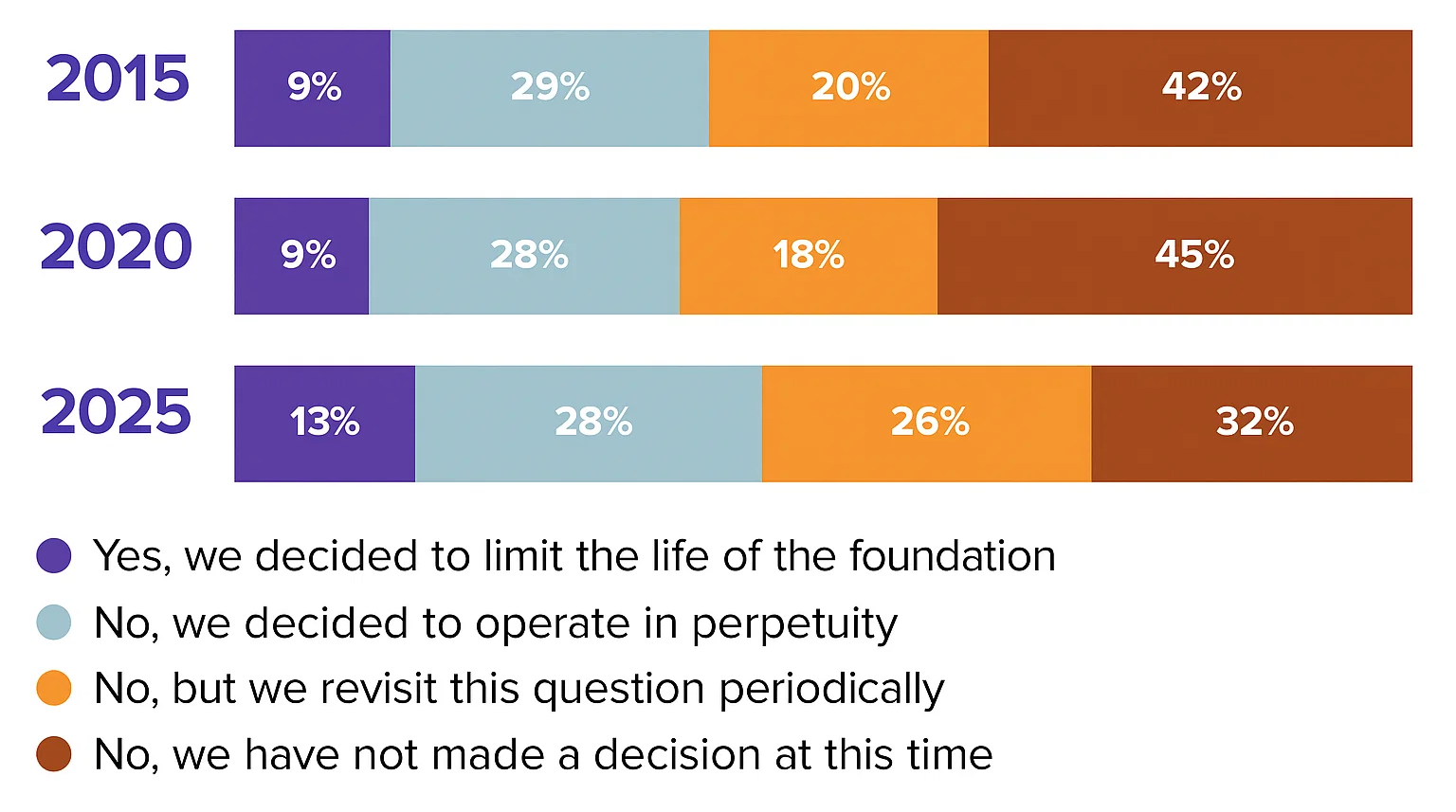
Research confirms this is a growing trend. The National Center for Family Philanthropy’s “Trends 2025” report reveals that more family foundations plan to limit the life of their giving — 13% in 2025 compared to 9% in 2015 and 2020. Additionally, one in four foundations periodically reviews whether to operate in perpetuity or limit the foundation’s life, compared to one in five in 2015 and 2020 (see figure).
Decision to limit the life of the foundation
Understanding How Spend-Down Impacts Compensation
Before initiating a spend-down, it is important to develop a compensation plan to encourage employee retention. Be transparent about the spend-down process and implications for individual roles. Without pay adjustments, staff might be tempted to quit, and filling vacancies could be difficult, as candidates would know the foundation’s end date.
“The organization can’t afford to lose institutional knowledge. It needs a leader to guide the organization through the spend-down period.”
– Judy Weinstein, Principal Consultant, The Croner Company
Fostering retention comprises an essential component of the spend-down’s risk mitigation strategy. Announce retention efforts and new compensation elements when you announce the spend-down date.
Implement a Two-Pronged Approach: Pay Positioning and Retention
Pay Positioning:
Foundations spending down assets must establish new methods for determining compensation rates. “Asset size” cannot be the sole pay benchmark for executives, given the endowment will shrink as the foundation spends down.
Foundations need to benchmark pay based on what similar organizations offer for the complexity and scope of work accomplished. “Defining similar organizations becomes more complicated when a foundation is spending down,” explained Syde.
“They also need to reassess their target pay positioning in the market,” added Weinstein. Increasing compensation encourages retention and rewards staff for the additional work required to administer larger gifts in a compressed timeline.
“Many spend-down organizations are working with leaner teams, and one of the results is they can justify higher pay.”
– Judy Weinstein, Principal Consultant, The Croner Company
Central to any pay increase is ensuring that compensation remains “reasonable and defensible.” Staff compensation, including salaries, benefits and reimbursements, must be reasonable and not excessive to maintain tax-exempt status.
“To effectively support their clients, experienced consultants should understand the nuances of spend-down compensation,” said Syde. “They can help foundations identify organizations navigating comparable circumstances for benchmarking. They can also assist with career progression planning to enable employees to move into higher-paid roles with expanded responsibilities as the spend-down progresses, and staff size decreases.”
Retention Planning:
When developing retention incentives; start with the communications plan. “Communicate the spend-down timeline — early and often — and its impact on all staff members and programs,” recommended Syde.
Also, clearly articulate to employees new retention benefits. To improve retention, spend-down foundations can:
- Increase 401(k)/401(3b) contributions
- Offer severance packages
- Pay for education and professional development
- Provide outplacement coaching, i.e. career counseling, training and financial planning to sustain employees post end date
- Develop career ladders and promotion criteria, enabling employee to grow while remaining at the foundation
- Provide flexibility for job interviews
- Offer references
- Incorporate career transition into performance management reviews
- Establish a pledged minimum termination notice for each position
- Develop long-term incentives with vesting near or at end date
“Take time in advance to develop a road map. Identify what and who you need to support the foundation throughout the spend-down period,” advised Syde. Weinstein concurred. “Plan early. Have the people plan be part of the strategic plan,” she added.
Pay particular attention to executive pay benchmarking urged Syde. “The earlier you begin benchmarking the better. An early start ensures consistent data that supports competitive and reasonable compensation,” he said.
“It’s critical for executives to have a defensible market lens,” Weinstein added. “That is essential to keeping them on board and committed to the mission,” she concluded.
The Croner Company’s surveys and consulting services are relied upon by organizations at all stages of growth to establish and modify pay practices and align compensation with mission, values and market.
- To learn more about our consulting services, please contact Lisa Dyakovski, Senior Consultant at the Croner Company, at (415) 485-5516 or lisa@croner.com.
- For more information about The Croner Company’s compensation surveys, please contact Laurie Krashanoff, Manager, Account Relations, at +(415) 485-5521 or laurie@croner.com.